How Much Protein In A Chicken Drumstick
A practical step-by-step guide to how much protein in a chicken drumstick, including preparation, instructions, common issues, tips, and next steps.
How Much Protein In A Chicken Drumstick
Understanding the exact protein content in your food is key to hitting your fitness and nutrition goals. A chicken drumstick is a popular, affordable source of high-quality protein, but the exact amount can vary significantly based on its size, whether you eat the skin, and how it's cooked. This guide provides a clear, step-by-step process to accurately measure and calculate the protein in any chicken drumstick, empowering you to track your intake with precision.
Fast Answer
- Average Cooked Drumstick: A medium, roasted drumstick with the skin on (about 100g / 3.5 oz of meat and skin) contains roughly 27 grams of protein.
- Meat Only: The same drumstick with the skin removed (about 85g / 3 oz of meat) has around 24 grams of protein.
Before You Start
To get an accurate protein count, you can't rely on guesswork. "Medium" or "large" are subjective terms that can lead to miscalculations. The only way to know for sure is to weigh the edible portion of your food. This process is simple and requires just a couple of basic tools. Having these ready will make the process quick and seamless.
- Digital Kitchen Scale: This is the most important tool. It must be able to measure in grams for the best accuracy.
- Small Plate or Bowl: To hold the chicken meat while you weigh it.
- Nutrition Data Source: A reliable source for nutritional information. We highly recommend the USDA FoodData Central website, as it's a comprehensive and unbiased database. A quality nutrition tracking app can also work.
- Your Cooked Chicken Drumstick: The method works best with a drumstick that has already been cooked, as this is the state in which you'll be eating it.
Step-by-Step Instructions
Follow these steps to precisely determine the protein in your chicken drumstick. This method moves beyond estimates and gives you a number specific to the exact portion you are eating.
Prepare Your Weighing Station
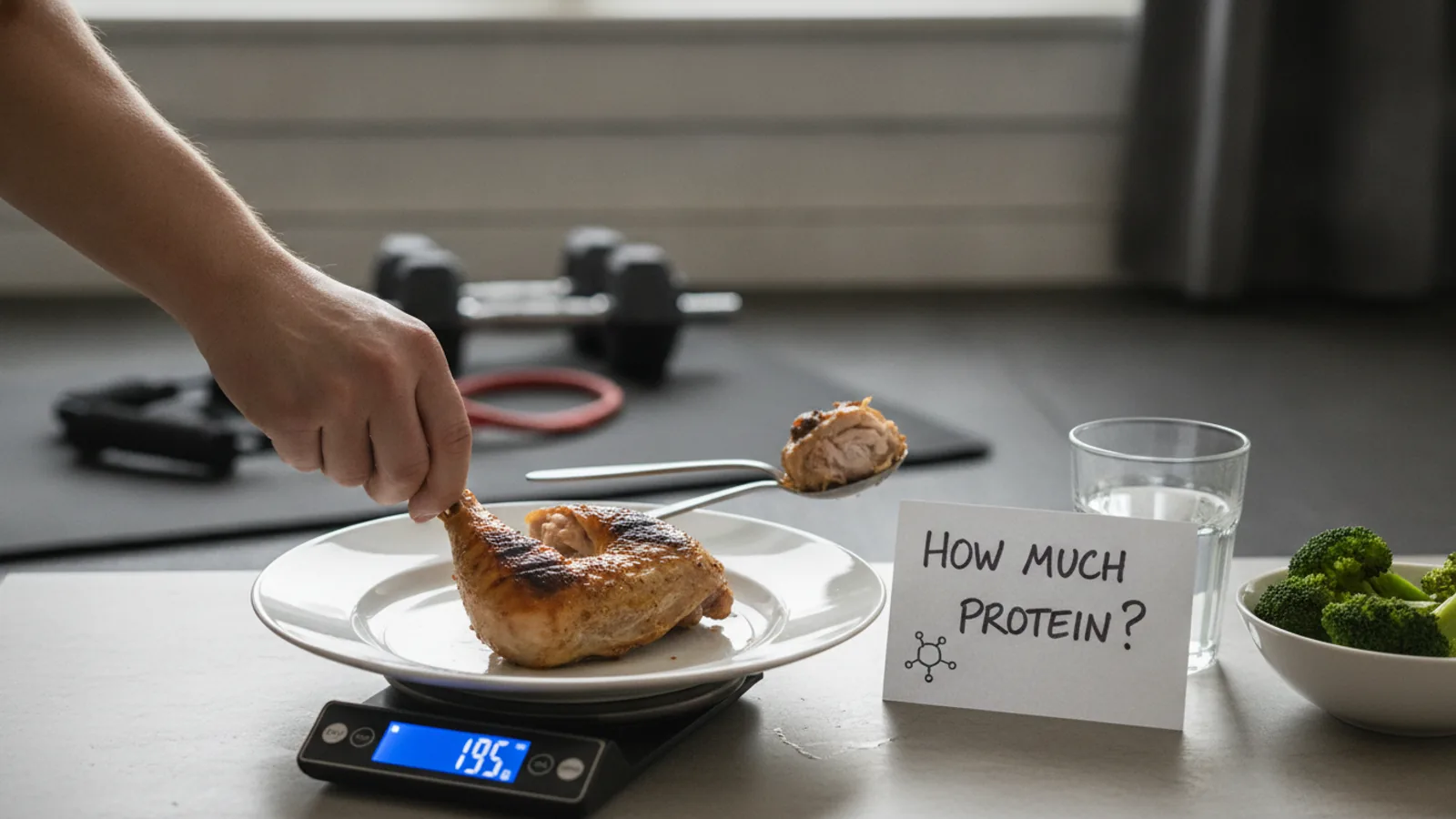
Before you begin, make sure your kitchen scale is on a flat, stable surface. Turn it on and place your empty plate or bowl on top of it. Press the "Tare" or "Zero" button. This subtracts the weight of the plate, ensuring the scale only measures the food you add. The scale should read "0 g" before you proceed.
This step is critical for accuracy. Forgetting to tare the scale is the most common mistake and will result in a completely incorrect measurement of your food's weight, throwing off all subsequent calculations.
Separate the Edible Portions
Using a fork and knife or your hands, carefully remove all the meat and skin from the drumstick bone. Place all the edible parts onto the tared plate on your scale. Be thorough and get as much meat off the bone and cartilage as you can. Discard the bone.
If you do not plan to eat the skin, separate it from the meat now and discard it as well. The protein and calorie count will be different depending on whether you include the skin, so decide how you plan to eat it before you weigh.
Record the Weight of the Edible Portion
Look at the final number on your digital scale. This is the total weight of the edible portion of your chicken drumstick in grams. Write this number down. For example, let's say the meat and skin from your drumstick weigh 115 grams.
This weight is the most important piece of data you'll collect. It's the foundation for calculating the final protein amount. An "average" drumstick might have around 80-120 grams of meat, so your number will likely fall in this range, but it can vary widely.
Find the Correct Nutritional Data
Now, open your chosen nutrition data source. Using the USDA FoodData Central website is recommended for its accuracy. In the search bar, type in a specific description of your food. The more detail, the better.
Good search terms would be:
- "Chicken drumstick, roasted, meat and skin"
- "Chicken drumstick, roasted, meat only"
- "Chicken drumstick, fried, meat and skin"
Select the entry that best matches how your chicken was prepared. Look for the protein value, which is almost always listed per 100 grams of food. For our example, let's use the entry for "Chicken, broiler or fryers, drumstick, meat and skin, cooked, roasted." The USDA database shows this has approximately 27.2g of protein per 100g.
Calculate the Total Protein
With your two key numbers—the weight of your portion and the protein per 100g—you can now perform a simple calculation to find the total protein content.
The formula is:
(Your Portion Weight in Grams / 100) x Protein per 100g = Total Protein in Your Portion
Using our example numbers:
(115g / 100) x 27.2g = 1.15 x 27.2g = 31.28g of protein
So, the specific drumstick in our example contains about 31.3 grams of protein. You can now confidently log this precise number in your food journal or tracking app.
Quick Reference
Use this table for quick estimates when you can't weigh your food. These are average values based on USDA data and can vary based on the actual size of the drumstick.
| Chicken Drumstick Preparation | Protein per 100g (3.5 oz) | Why |
|---|---|---|
| Cooked (Roasted), Meat and Skin | ~27g | This is a standard, balanced value for a common preparation method. |
| Cooked (Roasted), Meat Only | ~28.5g | Removing the skin (which is mostly fat) makes the remaining portion slightly more protein-dense per gram. |
| Raw, Meat and Skin | ~19g | Raw meat contains more water. Cooking reduces water content, concentrating the protein into a smaller weight. |
| Cooked (Fried), Meat and Skin | ~26g | Frying can add oil and moisture from the batter, slightly lowering the protein density compared to roasting. |
Common Problems When Calculating Protein
Even with a simple process, a few common issues can arise. Here’s how to troubleshoot them for consistently accurate results.
- Problem: Forgetting to tare the scale with the plate on it.
If you weigh the plate along with the food, your starting weight will be incorrect, leading to a wildly overestimated protein count.
Fix: Make it a habit to always hit the "Tare" or "Zero" button after placing your empty container on the scale and before adding any food. - Problem: Using a generic "chicken" entry in a tracking app.
Not all chicken parts are equal. A chicken breast is much leaner and has a different protein-to-fat ratio than a drumstick.
Fix: Always be as specific as possible in your search. Include the cut ("drumstick"), the cooking method ("roasted," "fried"), and whether the skin is on or off. - Problem: Confusing cooked weight data with raw weight.
As mentioned, this is a critical error. A 150g raw drumstick will weigh significantly less after cooking due to water loss, but the protein amount stays the same. If you weigh your 115g cooked portion but use data for raw chicken (~19g protein per 100g), you'd incorrectly calculate only 21.8g of protein instead of the more accurate 31.3g.
Fix: Double-check that your data source specifies "cooked," "roasted," "grilled," or whatever method you used. If you only have raw data, you must weigh the meat before cooking, which is less practical for tracking a single meal. - Problem: Not accounting for heavy sauces or marinades.
A thick BBQ sauce or breading adds weight, carbohydrates, and fat, but very little protein. If you weigh the drumstick with a heavy coating, you're measuring the sauce as much as the chicken.
Fix: For the most accurate measurement of the chicken itself, scrape off any excess, thick sauce before weighing. For breaded chicken, use a database entry for "fried chicken with breading" to get a more appropriate nutritional profile.
Advanced Tips for Protein Tracking
Once you've mastered the basics, these tips can help you save time and increase your accuracy even further.
- Calculate a Personal Yield Percentage: If you often cook drumsticks in bulk, try this. Weigh a full batch of raw drumsticks (e.g., 1000g). Cook them all using your typical method. Then, weigh all the cooked, edible meat and skin. Let's say the final edible weight is 650g. This means your personal yield is 65% (650g / 1000g). In the future, you can simply weigh your raw drumstick, multiply by 0.65 to get the estimated cooked edible weight, and calculate the protein from there without needing to de-bone a hot piece of chicken every time.
- Create a "Recipe" in Your Tracking App: Most nutrition apps allow you to create custom recipes. You can create an entry for "My Roasted Chicken Drumstick" and input the protein per gram based on your own accurate calculations. This way, you can simply log "115g of My Roasted Chicken Drumstick" in the future, and the app will do the math for you.
- Understand the Role of Bones: The bone and connective tissue typically account for about 25-30% of the total weight of a raw chicken drumstick. This is useful to know when you're buying chicken by the pound and trying to estimate how much edible meat you'll actually get.
How Much Protein In A Chicken Drumstick FAQ
Is the protein in chicken drumsticks a "complete" protein?
Yes. Chicken, like all animal meats, provides a complete protein source. This means it contains all nine of the essential amino acids that your body cannot produce on its own. These amino acids are crucial for muscle repair, hormone production, and overall bodily function.
Does eating the chicken skin add much protein?
The skin does contain some protein, primarily from collagen, but it is mostly composed of fat. For a typical drumstick, the skin might add 2-3 grams of protein but also 8-10 grams of fat. If your goal is to maximize lean protein intake, it's best to remove the skin.
How does the protein in a drumstick compare to a chicken breast?
A chicken breast is leaner and more protein-dense. Per 100g of cooked meat, a boneless, skinless chicken breast has about 31 grams of protein and very little fat. A skinless drumstick has slightly less protein (around 28.5g) and more fat. Drumsticks are an excellent source of protein, but chicken breasts are the superior choice for the highest protein-to-calorie ratio.
Does the way I cook my drumstick change its protein content?
The cooking method does not change the total amount of protein in the chicken. A drumstick has the same amount of protein whether you roast it, boil it, or fry it. However, the cooking method does change the final weight and nutrient density. Roasting and grilling cause water and fat to drip off, making the final product more protein-dense per gram. Frying can add fat and weight from oil and batter.
How many drumsticks do I need to eat for 30 grams of protein?
This depends entirely on the size of the drumsticks. As calculated in our main example, one large drumstick can easily contain over 30 grams of protein. For smaller drumsticks, you would likely need two to reach that target. The only way to know for sure is to weigh them.
Final Checklist for Protein Calculation
Use this final checklist to ensure you've followed every crucial step for an accurate protein count every time.
- Did you use a digital kitchen scale that measures in grams?
- Did you place an empty plate on the scale and press the "Tare" or "Zero" button before adding food?
- Did you weigh only the edible portion (meat and/or skin) after removing the bone?
- Did you find a specific entry in a reliable database (like USDA FoodData Central) that matches your chicken's preparation (e.g., "roasted," "skin-on")?
- Did you confirm that the nutritional data you are using is for cooked chicken, not raw?
- Did you correctly apply the formula: (Portion Weight / 100) x Protein per 100g?
By following this guide, you can move past generic estimates and gain precise control over your nutritional intake, helping you better fuel your body and achieve your health and fitness objectives.